> ## Documentation Index
> Fetch the complete documentation index at: https://docs.transitionzero.org/llms.txt
> Use this file to discover all available pages before exploring further.
# Model calibration
> This page outlines TransitionZero's model calibration standard met by all models on Scenario Builder
# Changelog
Model calibration standard published
# Model Calibration
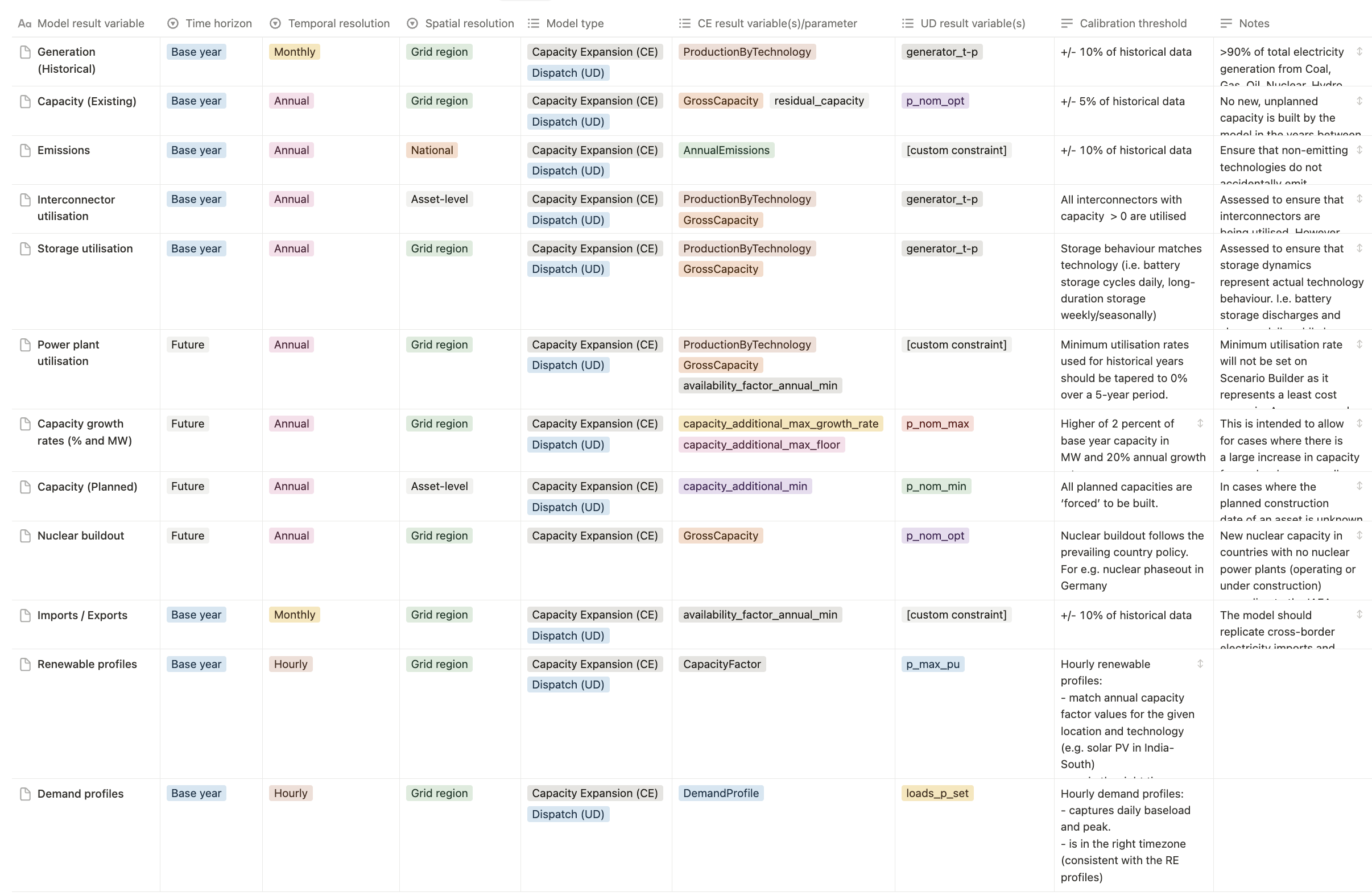
The table below sets out the calibration standard for all energy system models that will be built at TZ. It applies to both Capacity Expansion (tz-osemosys) and Unit Dispatch (PyPSA). The calibration standard is country- and scenario-agnostic. This means that it applies to all countries and all scenarios. It consists of a list of model results that should be checked against their respective calibration thresholds to consider a model ‘calibrated’. It also specifies the resolution - spatial and temporal - at which these calibration thresholds should be applied. For e.g. Emissions in the base year should be within +/- 10% of actual historical data for the base year.
Model calibration is an essential step in building credibility. The goal of calibration is produce models that analysts can use with confidence. A calibrated model will both reproduce historical energy system trends as well as plausible future energy system pathways. A basic calibration covers capacities, generation, emissions, and trade at a relatively coarse resolution (annual for an entire country). As model and data availability improves, calibration will performed at higher resolution (e.g. hourly for each region) and for a wider range of metrics (e.g. electricity prices). Higher standards of calibration will increase the data and modelling requirements for a given electricity system. For e.g., calibrating a model for electricity prices will require improvements to the model representation of ancillary services, capacity markets etc. as well as remuneration data related to each.
Below is a step-by-step guide to the model calibration process:
**1. Gather historical data:**
* Collect reliable historical data for the calibration period for the relevant metrics.
* Ensure the data is consistent with the model's temporal and spatial resolution.
**2. Identify calibration parameters (set in the ‘Calibration standard’ table below)**
* Select the model parameters that can be adjusted to improve the fit with historical data.
**3. Implement Calibration Strategy**
* **Manual Calibration:** Adjust parameters, run the model, compare results to historical data, and repeat.
* **\[Future work] Automated Calibration:** Use optimisation algorithms to find the parameter set that minimises the difference between model results and historical data.
**4. Compare model results with historical data:**
* Compare the model outputs with the historical data for the chosen metrics.
* Calculate error metrics against the calibration threshold for each of the chosen metrics
**5. Iterate and Refine:**
* If the model results do not adequately match the historical data, repeat Steps 4 and 5.+
* Adjust parameters and re-run the model
**6. Validation:**
* Validate the calibrated model by comparing its performance for future years and measuring it against the calibration threshold.
# Calibration Standard
[Click here to view the full calibration standard](https://transitionzero.notion.site/model-calibration?v=1e49ab42b13581e4946d000c65225d6f)